

Key takeaways
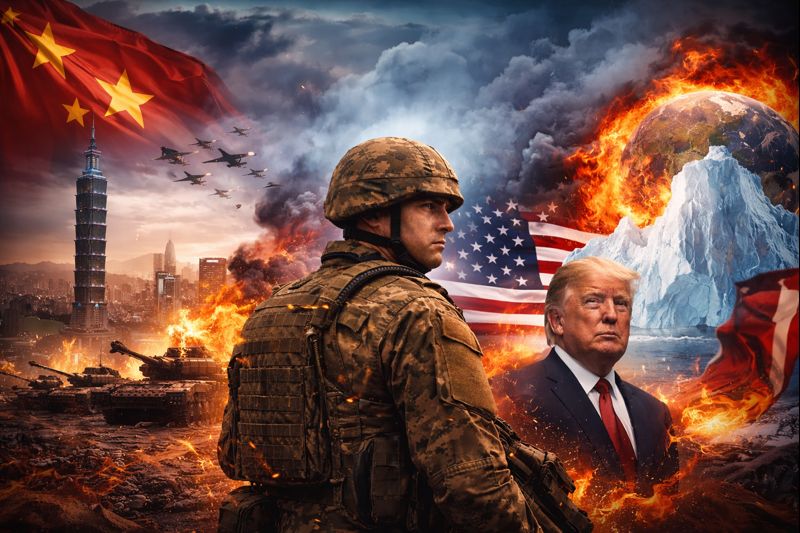
- NATO’s chief has warned Europe to prepare for a war on a world-war scale.
- Taiwan says China’s pressure now mixes drills with cyber and disinformation tactics.
- The White House says Trump is considering options to acquire Greenland, including military force.
- Sweden, Poland, and Lithuania have issued civil-defence guidance aimed at household readiness.
- SIPRI says global military spending rose to about $2.72 trillion in 2024, up 9.4%.
For years, leaders talked about war as a distant risk. Now they are speaking as if it could return to Europe in a form people have not seen in generations. NATO Secretary General Mark Rutte has warned allies to prepare for a conflict “on the scale” their grandparents faced, with mass mobilisation and heavy losses. That warning is landing at a time when several major flashpoints are heating up at once.
In Asia, Taiwan’s security officials say China is tightening pressure through large military drills and “hybrid” tactics such as cyber activity and disinformation. Beijing says it is defending its claims, while Taipei says the goal is intimidation and erosion of public confidence.
In the Arctic, the White House has said President Donald Trump is considering multiple options to acquire Greenland, including the possible use of the U.S. military. Denmark and Greenland have rejected the idea, and European leaders have treated the statement as a serious stress test for regional security.
Put simply, this is why the “WW3” fear is spreading. It is not just one crisis. It is several at the same time, involving the world’s biggest powers. In that kind of environment, the biggest danger is not always a planned invasion. It is a chain reaction. One incident triggers retaliation, then alliances get pulled in, and the conflict grows faster than anyone expects.
Europe’s public mood is shifting because governments are preparing civilians, not just soldiers.
Sweden’s official civil-defence guidance says everyone aged 16 to 70 is part of Sweden’s “total defence” and can be required to serve in war or under the threat of war. Poland has issued a national household safety guide focused on what families should do during emergencies, including where to go and what to keep at home. Lithuania has also published official guidance on how civilians should act in crisis or wartime conditions.
France’s debate has turned sharper too. General Fabien Mandon, one of the country’s top military leaders, has warned that France must be ready for the possibility of “losing its children” if a major war comes.
Money is moving in the same direction as the rhetoric. SIPRI estimates global military spending reached about $2.72 trillion in 2024, up 9.4% in a single year, and about 2.5% of global GDP. This does not prove a world war is coming, but it does show that governments worldwide are spending as if they expect a more dangerous decade.
Some claims going viral online say war in 2026 is “highly likely” and that multiple countries are about to attack neighbours. Those predictions are not confirmed facts. What is confirmed is that governments are openly planning for worst-case scenarios and telling the public to prepare.
For people worried about savings and financial holdings, the key point is that markets often move before wars officially “start.” Higher war risk typically shows up through energy prices, shipping and insurance costs, currency swings, and heavier government borrowing for defense.
So is this a signal for World War III? It is not proof. But it is a clear signal that governments think the risk has risen enough to warn their citizens and reorient their militaries. The next stage to watch is concrete action: major troop mobilisations, direct clashes involving big militaries, sustained attacks on shipping lanes, or a Taiwan incident that pulls U.S. forces into a fight.
Leave a Reply